

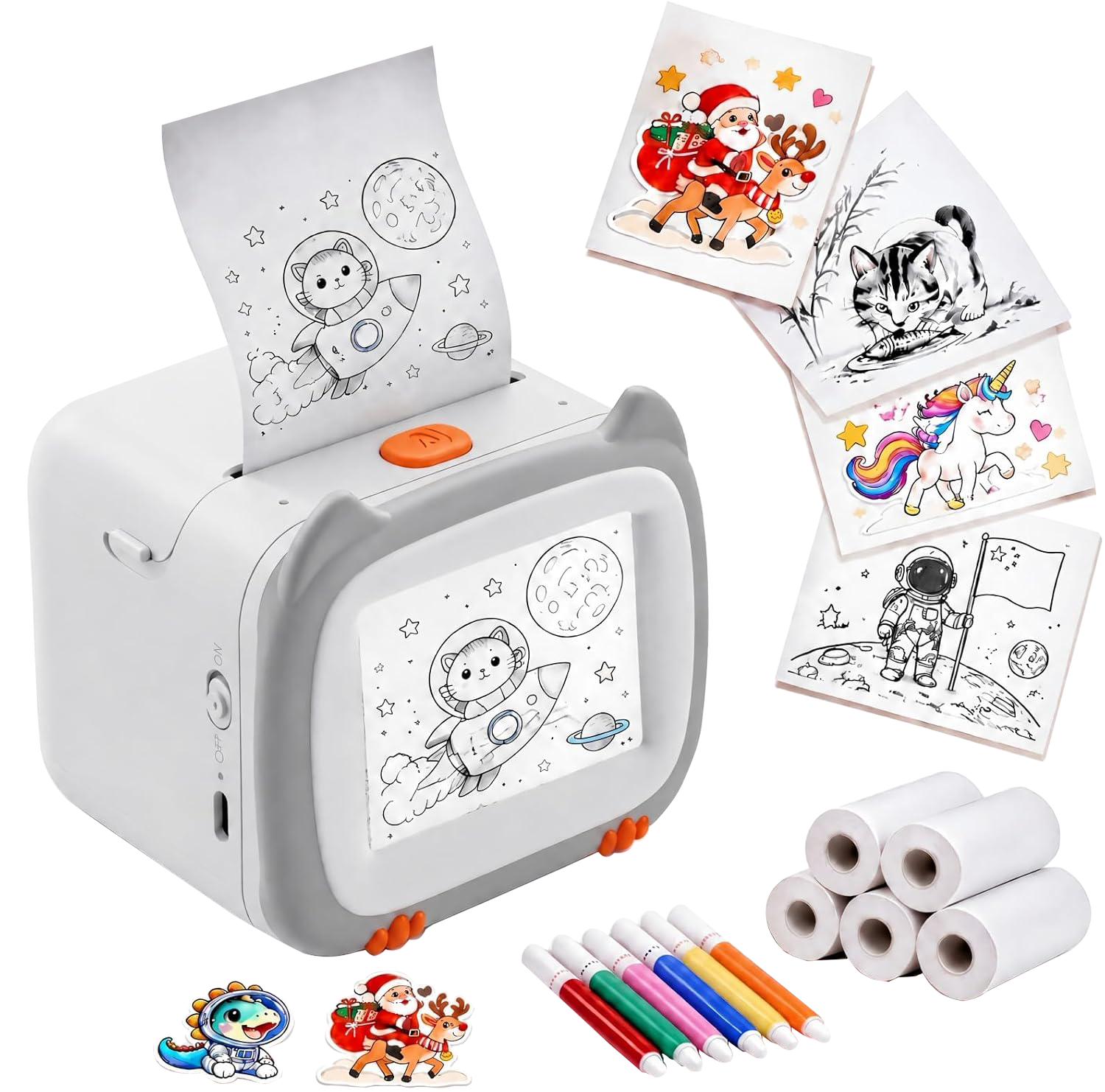
AI Voice Printer: What Buyers Should Check Before Ordering
Why the AI voice printer category is moving
The AI voice printer sits at a useful intersection for overseas buyers. It combines voice prompts with portable thermal printing, so the product reads as a learning tool in the home and a practical label or note device in daily use. The variants that sell are not complicated: voice playback, wrong-answer printing for study routines, and compact thermal output. These are use cases, not claims. How well each one performs depends on configuration, firmware and the app or content package the buyer chooses.
For brand owners and e-commerce sellers, the appeal is straightforward. The category has visible function at a demo table, it photographs well for listings, and it fits several price bands. That flexibility is also the risk. A voice printer bought on price alone often arrives with a firmware build that cannot be localized, a print path that jams on thicker stock, or packaging that fails marketplace requirements. Buyers should treat the category as an operations problem, not a sourcing checkbox.
JPHUI is a Shenzhen-based OEM ODM manufacturer working across AI voice printers, sticker printers for kids, drawing robots and mini cameras. The company runs in-house mold making and injection molding, and handles industrial design through to mass production. That matters in this category because the housing, paper path and button layout are where most change requests land.
What the product line covers
The AI voice printer is the lead item. It supports voice playback, wrong-answer printing and portable thermal printing, with the exact feature set depending on configuration. The same thermal platform supports sticker printer for kids variants, where the housing, button set and bundled content change the positioning. A drawing robot sits alongside these as a separate build, and the mini camera line, including action camera and AI camera types, gives buyers a second hardware category to test with the same supplier.
This range is useful for sellers building a small catalog rather than a single SKU. A voice printer and a sticker printer for kids can share packaging language and a brand identity. A drawing robot or mini camera can be added later without opening a new supplier relationship.
Certification is part of the baseline. Products are CE, FCC and RoHS compliant, which covers the main requirements for the US, EU and Canadian markets the company targets. Buyers still need to confirm label content, importer details and marketplace documentation for their own channel.
MOQ, lead time and landed cost
The numbers buyers ask about first are simple. MOQ is 300-400 pcs. Mass production lead time is about 20 days. FOB Shenzhen pricing runs USD 5-22 per unit, with the final figure depending on configuration, housing, accessories and packaging.
Shipping is usually the part that surprises new buyers. DHL to the US takes 8-12 days at roughly USD 8-10 per kg. That rate is an express benchmark, not a landed-cost calculation. Buyers should model unit weight, retail packaging, carton dimensions and any insert or manual before they commit to a retail price. A lighter, simpler retail pack often does more for margin than a small FOB concession.
- MOQ: 300-400 pcs
- Mass production: about 20 days
- FOB Shenzhen: USD 5-22 per unit
- DHL to the US: 8-12 days, roughly USD 8-10 per kg
- Payment: T/T, PayPal or Western Union
- Warranty: one year; the customer ships the faulty unit back at their own cost and a replacement is sent
The warranty terms are worth stating plainly in the listing and in the distributor agreement. A one-year warranty with customer-paid return shipping is common in this segment, but it is not what every end user assumes. Sellers who explain it early get fewer disputes later.
Customization that actually changes the product
OEM and ODM work is where the category gets interesting. Brand customization covers logo, color and printed details. Packaging customization covers retail boxes, inserts and manuals. Product development customization can go further into housing changes, button layout and feature selection, depending on configuration and volume.
Because mold making and injection molding are in-house, a housing change does not have to wait on an outside tool shop. That shortens the loop between a sample review and a revised sample, though the actual schedule depends on the change and the current production load. Buyers should bring a clear brief: target market, retail price band, packaging format, and which features are fixed versus negotiable.
A realistic first order is often a small run of a proven build with custom branding and packaging, followed by a housing or feature change once sell-through is known. That sequence keeps tooling and inventory risk contained.
Buyer checklist before placing an order
Ask for a sample of the exact configuration you intend to sell, not a demo unit. Confirm the voice language and content package, since these depend on configuration and are easy to leave ambiguous. Check the retail box against your marketplace requirements, including label placement and importer information. Confirm the warranty wording and who pays return shipping. Get the carton weight and dimensions in writing so the DHL estimate is based on real numbers. Agree on payment terms in advance; T/T, PayPal and Western Union are all accepted.
Finally, decide whether the product is a voice printer, a sticker printer for kids, or both under one brand. The answer changes the housing, the accessories and the packaging, and it is cheaper to settle before the mold is cut.
