

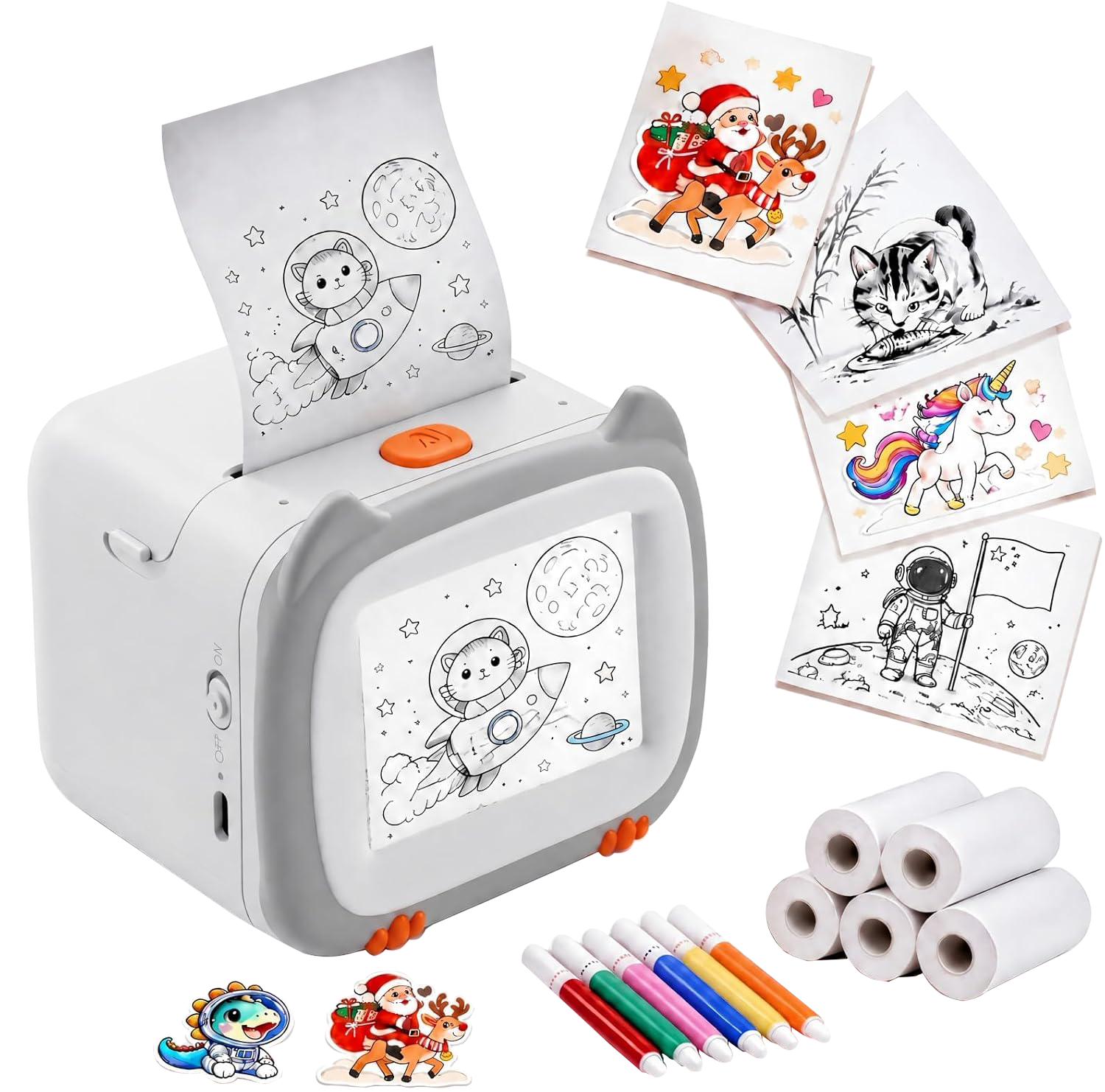
AI Voice Printer for Education and Home Use
What an AI Voice Printer Delivers in Practice
An AI voice printer is not a talking novelty—it is a functional thermal printer that accepts voice commands via built-in mic or paired app, converts speech to text, and prints on-the-spot. At JPHUI in Shenzhen, these units are engineered for repeat use in homes and classrooms: print math errors from voice notes, label craft supplies by speaking aloud, or generate flashcards from spoken vocabulary lists. No cloud dependency is assumed; core functions run offline once configured. The device uses standard 57 mm thermal paper rolls, fits in a child’s backpack, and draws power from a USB-C port or internal rechargeable battery depending on configuration.
OEM and ODM Flexibility for Brand Owners
JPHUI supports full OEM and ODM engagement—not just logo placement or box redesign. Clients can specify button layout, wake-word phrasing, default paper size, companion app UI language, and even hardware-triggered actions like auto-print on voice detection. All customizations are validated across tooling, firmware, and packaging. The factory maintains in-house mold making and injection molding capacity, so design changes that affect housing or internal bracketing do not require external vendors. MOQ for fully customized versions starts at 300–400 pcs. Lead time for mass production remains about 20 days after final approval of BOM and artwork.
Integration with Other Product Lines
The AI voice printer shares firmware architecture and supply chain logic with JPHUI’s sticker printer for kids, drawing robot, and mini camera. For example, the same voice-to-text engine used in the printer also powers voice-command labeling in the sticker printer. Similarly, the mini camera’s edge-AI image tagging module reuses the same inference framework as the printer’s error-categorization feature. This cross-product alignment reduces firmware validation time and enables bundled SKUs—for instance, a ‘learning kit’ containing the AI voice printer plus a drawing robot that replays printed math problems as animated sketches. All units ship FOB Shenzhen, with DHL transit to the US taking 8–12 days at roughly USD 8–10 per kg.
Compliance, Warranty, and Logistics Realities
Every AI voice printer carries CE, FCC, and RoHS marks—verified through third-party labs accredited to ISO/IEC 17025. There is no self-declaration. Certification documentation is provided upon request and includes test reports covering radiated emissions, conducted immunity, and restricted substance analysis. Warranty covers manufacturing defects for one year. If failure occurs, the customer ships the unit back at their own cost; JPHUI replaces it within 5 working days of receipt. No repair-in-place service is offered. Payment terms are T/T, PayPal, or Western Union. USD receipts are issued against Hong Kong HSBC account details. No letters of credit or open account terms are supported.
Why Buyers Choose This Manufacturer Over Others
Three operational factors differentiate JPHUI: First, vertical integration—ID design, mold making, injection, PCB assembly, and final testing all occur under one roof in Shenzhen. Second, responsiveness on small-batch iteration: a firmware tweak to change voice feedback tone or add a new language pack can be delivered in under 10 days for orders above MOQ. Third, consistency in component sourcing: key ICs (audio codec, thermal print head driver, BLE SoC) are sourced from fixed-tier suppliers with multi-year agreements, avoiding mid-run substitutions. These are not claims about ‘quality culture’ or ‘customer focus’—they are verifiable constraints baked into the production schedule and bill of materials. For brand owners shipping to EU or US retail channels, that traceability matters more than glossy spec sheets.

