

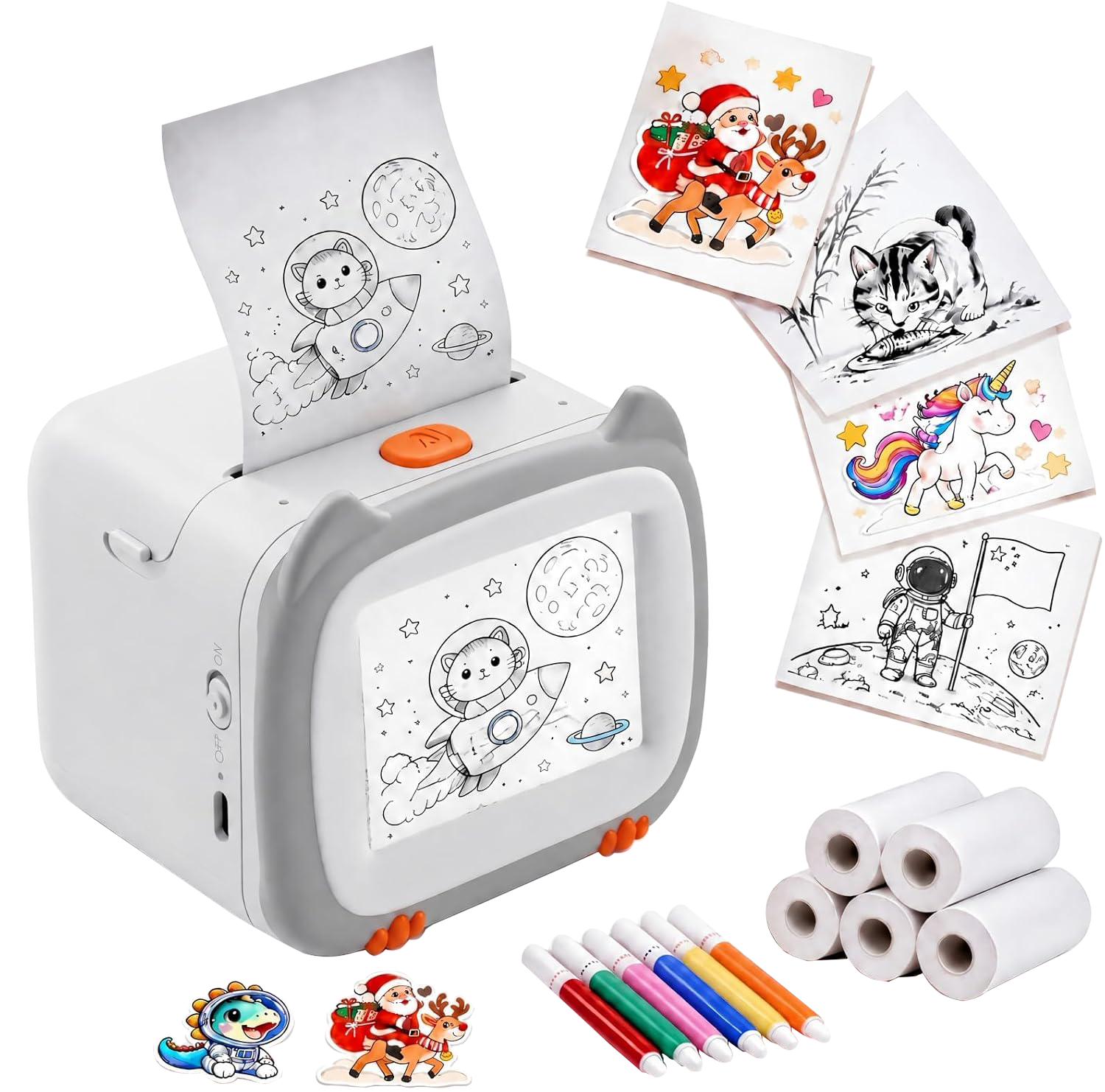
Sticker Printer for Kids: OEM/ODM Manufacturing in Shenzhen
Why Sticker Printers for Kids Are Scaling Fast
Sticker printers for kids have moved beyond novelty. In US and EU households, they now serve as entry points to digital creativity—supporting school projects, reward systems, and personalized crafts. Demand is rising not just among parents but also among e-commerce sellers and edtech brands launching branded learning kits. Unlike generic thermal printers, kid-focused models require deliberate safety design, intuitive UI, durable housing, and low-barrier interaction—like voice prompts or one-button printing. These constraints make manufacturing more specialized than it appears.
OEM/ODM Capabilities for Kid-Centric Hardware
JPHUI in Shenzhen supports full-cycle development for sticker printers aimed at children. This includes industrial design tailored to small hands and visual literacy, custom firmware for simplified workflows (e.g., voice-triggered sticker generation), and packaging that meets regional retail standards—blister packs for Walmart shelf placement or gift-ready boxes for Amazon FBA. The company owns its mold-making and injection molding lines, enabling rapid iteration on enclosure shapes, button placement, and port covers. No third-party tooling delays. All customization—from logo embossing to bilingual voice prompts—is managed in-house. Minimum order quantity is 300–400 pcs depending on configuration, with mass production lead time of about 20 days after final sample sign-off.
Compliance and Safety Built In
Kid-targeted electronics face stricter scrutiny. JPHUI ensures every sticker printer model complies with CE, FCC, and RoHS before shipment. These are not add-on certifications; they inform material selection (e.g., ABS housing free of phthalates), circuit layout (EMI shielding around audio components), and thermal management (no surface hotter than 45°C during continuous use). Battery compartments meet EN62115 mechanical requirements where applicable. Documentation—including test reports and DoC—is provided to clients for their own regulatory submissions. No exceptions, no shortcuts.
Logistics and After-Sales Clarity
Orders ship FOB Shenzhen. Unit pricing ranges from USD 5 to USD 22 depending on features: basic thermal-only units sit at the lower end; those with integrated AI voice modules, rechargeable batteries, or Bluetooth 5.2 connectivity command higher tiers. DHL express is the default international channel—8–12 days to the US, roughly USD 8–10 per kg. Clients receive tracking within 24 hours of dispatch. Warranty is one year from date of delivery. If a unit fails under normal use, the customer ships it back at their expense; JPHUI sends a replacement within 5 working days of receipt. There is no advance replacement program, no local service centers, and no return shipping coverage—terms clearly stated in the proforma invoice.
Beyond Stickers: Adjacent Product Lines
While sticker printers for kids form a core vertical, JPHUI’s platform architecture allows functional overlap across related categories. The same thermal print engine and compact chassis used in a child’s sticker printer can be reconfigured into an AI voice printer for homework review—supporting spoken math problems and instant flashcard output. Similarly, the image capture module from their mini camera line integrates into drawing robots for real-time sketch digitization. This modularity reduces NRE for clients expanding into complementary SKUs. For example, a brand launching a sticker printer can later introduce a matching drawing robot using shared firmware infrastructure and battery specifications—cutting development time by up to 40% versus starting from scratch. All products are built for the same target markets: US, EU, and Canada—with documentation, labeling, and plug types pre-adapted.
Payment and Operational Flexibility
Payment terms are T/T, PayPal, or Western Union—no letters of credit or escrow required for standard orders. A 30% deposit secures production scheduling; balance is due before shipment. Clients may request partial shipments against single POs if warehouse capacity or cash flow requires staggered delivery. Sample lead time is 7–10 days for existing configurations; new ID development adds 12–15 days. All prototypes ship via DHL with full traceability. No NDAs are required to access spec sheets or factory audit reports—JPHUI shares these openly upon qualified inquiry. Factory visits are possible with 5 working days’ notice, subject to production calendar availability.

