

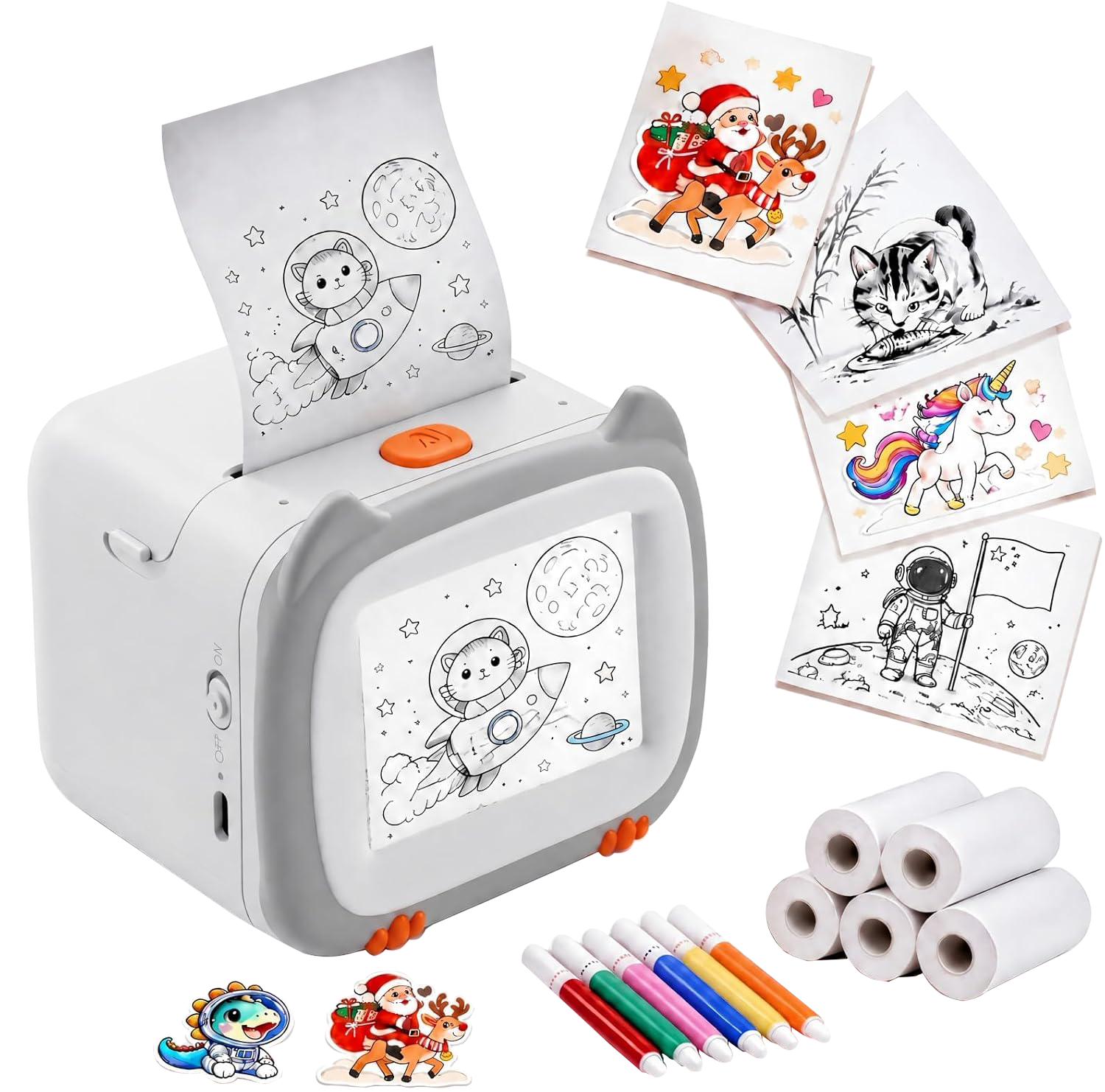
AI Voice Printer for Education and Home Use
What an AI Voice Printer Delivers in Practice
An AI voice printer is not a smart speaker with printing add-ons. It is a dedicated thermal printer that accepts voice input via built-in mic or paired app, converts speech to text in real time, and prints on-the-fly—no PC or cloud dependency required. At JPHUI, the device handles bilingual voice commands (English and Mandarin by default), stores up to 500 voice-triggered print jobs locally, and supports repeat printing of saved phrases. It does not require continuous internet: offline mode retains core voice-to-print functionality using on-device ASR models optimized for short educational phrases—'five times seven', 'spelling of "necessary"', or 'show me the capital of Peru'.
OEM and ODM Flexibility Starts at Low Volume
JPHUI supports full OEM and ODM engagement: logo placement, custom UI language strings, branded packaging, and hardware configuration changes—including button layout, casing color, and microphone sensitivity tuning. All are feasible starting at MOQ 300–400 pcs. There is no fixed tooling fee; cost allocation depends on the scope—e.g., a new housing mold carries higher NRE than label-only branding. The company owns its injection molding lines and CNC tooling workshop in Shenzhen, so design iterations move directly from CAD to prototype within 12–15 working days. Mass production lead time remains stable at about 20 days after final sample sign-off and deposit receipt.
Logistics and Warranty: Clear Terms, No Assumptions
Shipping is FOB Shenzhen. DHL Express is the standard method for overseas buyers: 8–12 days to the US, roughly USD 8–10 per kg. A typical AI voice printer unit weighs between 0.28–0.42 kg depending on configuration, so landed freight cost per unit falls between USD 2.20 and USD 4.20. Payment accepts T/T, PayPal, or Western Union—no LC or open account terms. Warranty is one year from shipment date. If a unit fails under normal use, the customer ships it back at their own cost; JPHUI sends a replacement within 3 working days of receipt. No data recovery, no firmware rollback service—only hardware replacement.
Certifications and Market Readiness
All AI voice printers ship with CE (for EU), FCC (for US), and RoHS compliance documentation. These are not self-declared: test reports come from Shenzhen-based CNAS-accredited labs, covering radiated emissions, conducted immunity, and restricted substances. No additional regional certifications—such as UKCA or IC—come standard but can be added per order if required. Product labeling includes bilingual English/Chinese safety warnings and battery disposal instructions, printed directly on the rear housing. Packaging inserts are customizable: multilingual quick-start guides, QR-linked video tutorials, or blank space for buyer-branded content.
How It Fits With Other Products in the Line
The AI voice printer shares platform logic with JPHUI’s sticker printer for kids and drawing robot—same thermal print head supplier, same Bluetooth 5.0 module family, and overlapping firmware architecture. That enables cross-product feature porting: for example, a customer who orders both the AI voice printer and the sticker printer can request unified app control across devices, or shared voice command sets. The mini camera line uses separate imaging silicon but shares the same industrial design language and surface finish standards—matte ABS with soft-touch coating, consistent button tactility, and identical USB-C port placement depth. This coherence reduces buyer complexity when sourcing multiple SKUs. None of these products claim medical, diagnostic, or therapeutic function. They are consumer electronics intended for home learning, light creative use, and supervised child interaction.

